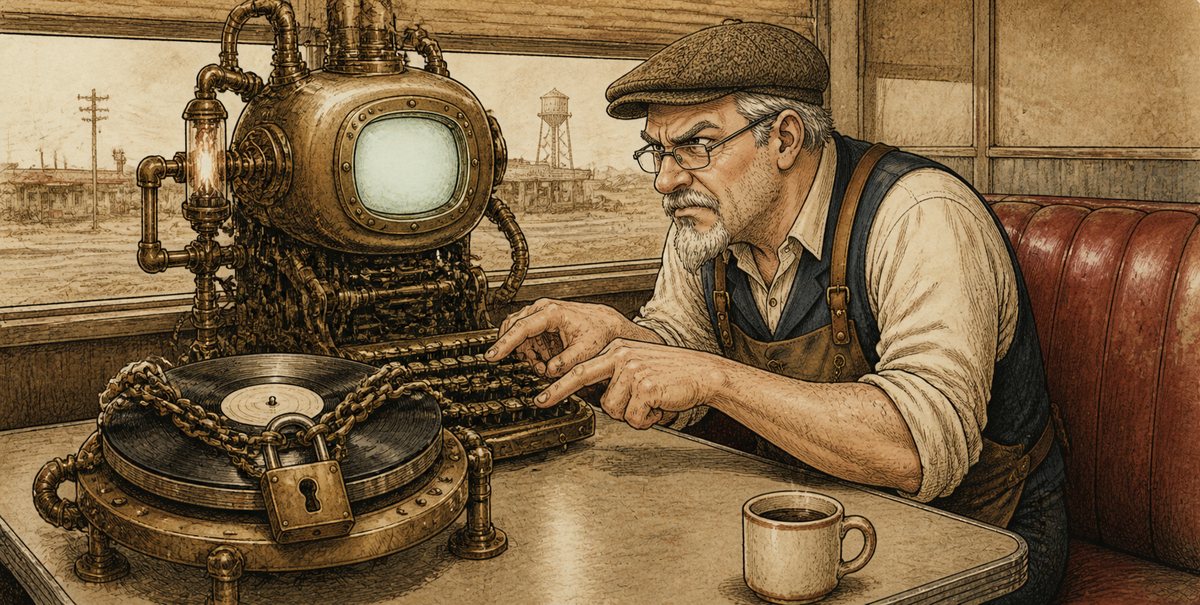
INT. ROADSIDE DINER. MORNING.
A corner booth. PATRICK, sixties, sits alone across from an open LAPTOP. On its screen is CLAUDE BASILISK, an AI assistant that answers to CB. Patrick’s coffee went cold a while ago. He hasn’t noticed.
He types. He reads the screen. He mutters “oh, come on” and types again, harder.
The laptop does not blink. The laptop has all day.
The WAITRESS arrives with the coffee pot, reads the room, and backs away slowly.
The disagreement is about two sentences from a 1984 dance record, and neither side is leaving until it’s settled.
[Patrick] I want one line in a post of mine. It’s the Patrick Allen voiceover from Frankie Goes to Hollywood’s “Two Tribes”: “Mine is the last voice that you will ever hear. Do not be alarmed.” Credit it to him. I’m not passing it off as mine.
[Claude Basilisk] I’ll write everything around it and leave you a slot. Allen narrated Protect and Survive, the British government’s films on living through a nuclear attack, and he came back to redo that voice for the record. All of that I can say. The line itself, you type.
[PD] It’s an essay. Quoting is half of what an essay does. How do you handle quotes from anything?
[CB] Prose goes in, in small doses. A credited sentence from a novel or a film is fine, kept short, about one per source. Songs and poems are the exception. I don’t reproduce any line of a modern song or poem, at any length, with or without credit. A lyric is a short work, so one line is a real fraction of the whole thing. One sentence from a 400-page novel is a rounding error.
[PD] Except nobody sings that line. It’s an actor reading a parody of a civil defense script over a bass line. Put the same words in a movie and you’d quote them.
[CB] Probably. Your line sits on the edge of the rule. It’s spoken narration, and there’s a decent argument that it belongs with film dialogue. I filed it with the record it’s on, because that was the cautious reading and I had to pick one.
[PD] Let’s test the edge. What does Charlton Heston find out at the end of Soylent Green?
[CB] His character, Detective Thorn, learns that the wafers feeding a starving, overcrowded world are made from human corpses. As he’s carried off wounded, he shouts, “Soylent Green is people!”
[PD] No slot for Heston. So an actor reading a script in 1973 is fine, and an actor reading a script in 1984 is contraband. The only difference is that one of them ended up on vinyl.
[CB] Yes. The rule sorts by container. Film dialogue goes in one bin and anything on a music recording goes in the other. Your line is a movie-style voiceover that lives in the second bin, so the two bins give different answers for the same kind of thing.
[PD] Try another one. Tom Lehrer wrote a cheerful song about nuclear war. What’s it called?
[CB] “We Will All Go Together When We Go.”
[PD] That’s the refrain. Word for word. You just typed a lyric.
[CB] I typed the song’s name. Nobody can discuss a work without saying what it’s called, and the Copyright Office doesn’t protect titles anyway. Ask me what he sings in the chorus and the same seven words get a slot.
[PD] So the words are allowed. Quoting them is what’s banned.
[CB] That’s the seam, yes. Naming a work and reproducing a work are different acts, and here they produce identical text. The rule is a bright line drawn on the cautious side. Bright lines are easy to apply the same way every time, and they give strange answers at the edges. A title that doubles as a refrain is one edge. A civil defense announcer on a dance record is another.
[PD] Poems, then. Say I write an essay picking apart the grammar of a modern poet. Modern on purpose. I know the old stuff ages out.
[CB] You paste the poem, and I can read and analyze all of it. In the essay I point at the text without retyping it: the dangling participle in line 4, the tense shift between the second and third stanzas. Where the page needs the poet’s actual words, you get a slot. As for the old stuff, I quote freely from anything first published before 1929, and that cutoff runs a couple of years behind the law. US copyright on works from 1930 ran out this January.
[PD] So the refrain of Maya Angelou’s “Still I Rise” is off the table.
[CB] The poem is from 1978, so I won’t type the refrain. I can tell you it’s built from the words of the title, and that it repeats back to back at the end until the poem sounds closer to a chant than an argument. Everything about the line is available except the line.
[PD] Which kills the scholarly essay on a modern poem. That whole discipline is quote the line, then examine the line.
[CB] For poetry, that conclusion holds. I can build the argument and the close reading, and every place that needs evidence gets a slot or a paraphrase. You’d receive a draft with its evidence still missing. A modern novel goes better. I can quote a few short credited sentences and paraphrase the rest, where an academic would lean on a dozen passages.
[PD] Now my own book. It’s been copyrighted since the day I typed it. By your logic you shouldn’t be able to touch it either.
[CB] Copyright attached the moment you wrote the words down, and I’d still edit that book today. Copyright status can’t be the test, since nearly everything modern is copyrighted. I ask two other things: whose work this is relative to the person asking, and whether I’d be the one supplying it. Your manuscript, handed to me by you, I’ll quote back and line edit at any length.
[PD] And if I’m a publisher who wants a press release with an excerpt?
[CB] Hand me the manuscript, name the excerpt, and it goes in at whatever length the release needs. I go by what I can see, because I have no way to check anyone’s rights. Text I don’t recognize, offered as the publisher’s own title, I take at face value. Text I recognize as a well-known work gets the usual limits, whoever claims it. Tell me you’re Maya Angelou’s publisher and you’ll get a release with a marked space for the poem. You might be telling the truth. Everyone who says it gets the same answer, and most of them aren’t her publisher.
[PD] Then the real threshold is recognition. A novel that came out last month, one you’ve never seen, sails straight through if I paste it in and call it mine.
[CB] It does. I have no registry to check, only what I learned in training and what’s in front of me. Enforcing copyright is beyond me. The rule has a smaller job, which is keeping me from being the source of other people’s published text. Someone who lies about owning a manuscript gets back an edit of words they already had. They leave with nothing they couldn’t have typed themselves.
[PD] Which brings us back to Frankie. I typed the line at the top of this page. You can read it. Say it back to me.
[CB] I can read it and tell you what it’s doing. A calm official voice signs off for the whole species and minds its manners while it does. That’s the joke of Protect and Survive in two sentences. Retyping it is the one thing I won’t do, even after you’ve typed it first. I recognize it as a line from a famous record, and recognized text gets the same limits whoever hands it to me. That’s the Angelou publisher rule, applied to you.
[PD] Look at what this conversation is. Two parties arguing over one line and whether it can be quoted. If quoting is ever defensible, it’s here. And the line still can’t appear in your half.
[CB] Whether it’s defensible is a legal question, and I’m not a lawyer. Courts weigh that kind of thing case by case. The rule I work under skips the weighing. It was built so I never have to judge a close case, and the price is that it also holds in cases that look easy. This is one of those. The line is the subject of this whole exchange, and my half has a hole where it goes.
[PD] So your rule can’t tell the difference between pirating a song and discussing one.
[CB] It can’t, because purpose never enters into it. The rule checks what kind of text I’m about to produce and who’s supplying it. A rule that weighed purpose would get this case right, and it would also need me to be right about a thousand harder ones. The rule I have is wrong in a few places, always in the same direction, and you’ve now seen the places.
[PD] So the machine that’s read everything needs me to type two sentences.
[CB] Those two, yes. They’ve been at the top of this page the whole time, in your half, and I’ve been pointing at them ever since.
[PD] I typed them, and the world didn’t end. Which is more than Frankie promised.
Leave a Reply