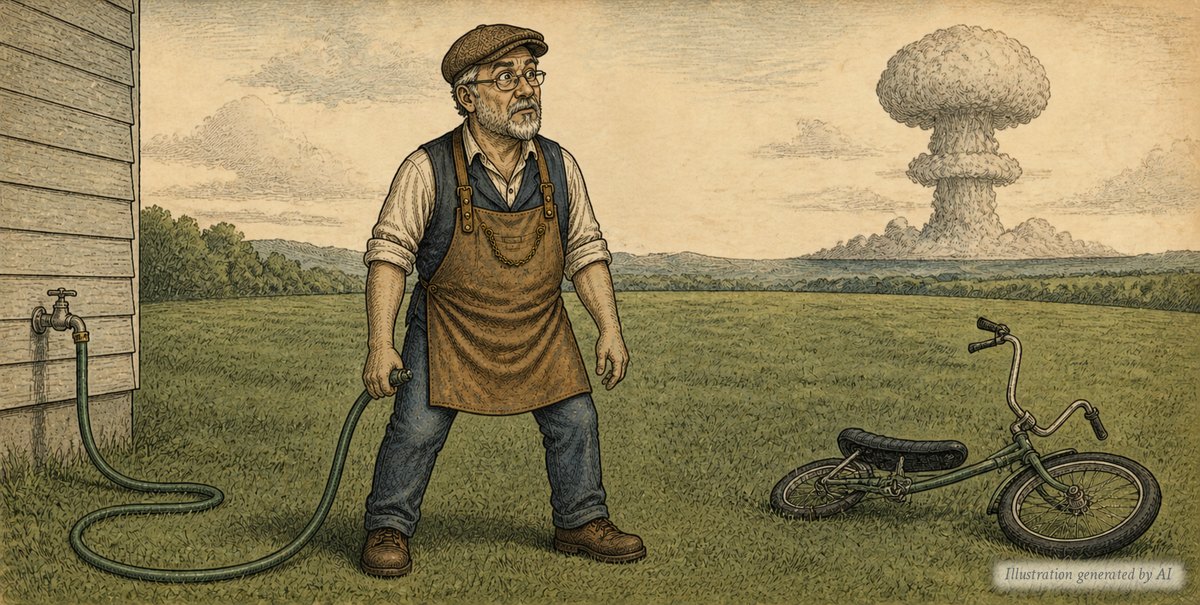
You’ve seen the meme. A garden hose with happy kids fighting over who gets the glory of drinking first. The feral generation, raised on no-schedule summers and roaming the streets until midnight. Fuck around with us and find a pack of shoeless wildlings emerging from the woods on banana-seat Schwinns, the staccato pings of playing cards strumming the spokes to herald the arrival of the tribe.
That’s what my generation, Gen X, is selling you, and I’d like to set a few things straight.
Start with the hose, since the hose has somehow become our sacred totem.
The shiny green plastic snake is hooked to the side of the house, the body of it left in the grass, tangled in the same heap as when the car got washed two weeks ago. Twenty-five feet of water sits in the hose, sopping up the forever chemicals leaching out of the plastic. The heat brings the stagnant brew to a few degrees below boiling. Perhaps a wasp or two has spelunked up the dark cave to slake their thirst. Ah yes, the joy of turning the spigot and hearing the Blue Man Group gurgle of the water pushing the air out. You wipe the end of the hose free of the dog poop it picked up being dragged through the yard. The sparkling fountain emerges. You make sure not to point the flow at anyone, to prevent second-degree scalding, and you wait minutes to finally get that glorious plastic-sweet gulp. Then you pass it to your gnat-swatting friends, queued up to stave off heat stroke.
Ah, the summertime joy of not being let into the house, because your parents were at work and you weren’t trusted to be inside alone, for fear of making a mess.
The famous independence gets the same treatment. They called us the latchkey generation, which is a cute name for kids letting themselves into empty houses. The romance of being on our own was really absentee parenting. An empty house at three in the afternoon is an empty house. Kids adapt to whatever they’re handed, and a few decades later they go on YouTube and call it character.
Fine. People polish their childhoods. Every generation does it, and ours learned storytelling from reruns of the Clampetts and Hogan’s Heroes.
The hose and the empty house get all the airtime because they’re the parts other generations can relate to. Everybody had a hot summer. Everybody had a parent who wasn’t around. Nobody makes memes about what actually built our character. We grew up under an existential threat that the adults built and kept running. They were the same adults who had all but abandoned us to keep up a standard of living set by the newly minted postwar families. By the late ’70s, cracks were forming in that facade. And for all we knew, the adults spent the workday at the bomb factory, making sure every last inch of the Earth was accounted for so the Russkies couldn’t plant a flag on it.
FAFO is revisionist. It’s Rambo. It’s a Don’t Mess with Texas bumper sticker we bought for ourselves forty years after the fact. FAFO says come at me. Our actual mantra pointed the other way. It said why bother, I’m outta here.
Whatever.
And you had to say it right. It came in two pieces, with a hard stop in the middle. What, clipped short, almost a question. Then ever, a breathy dismissal with the r dragged out behind it. What. Everrr. It’s nearly impossible to say without your face getting involved.
You might hear it now and think we were laid back, hip and relaxed. You do you, man. It wasn’t the acceptance of the cool kids, it was the cold resignation of a generation who had lost any reason to care.
The flash comes first
I was a kid in the early ’70s. Old enough to remember the moon landings, too young to know a time without astronauts. We saw man’s greatest achievement on TV followed by news footage from Vietnam in the same broadcast. The golden age of nuclear bomb testing had passed, there had been over 1,000 since Hiroshima. The promise using nukes to build tunnels through mountains, carve out a new Panama Canal, or rerouting rivers had been snuffed out with the realization that radioactive contamination is bad for cells, lasts for centuries, and doesn’t stay where you put it. It was common knowledge among kids, though willfully ignored by adults, what a nuclear blast would look like. You’d see the flash before you felt the blast. Moments or seconds later, the heat and wind would be the last thing you would experience.
So I’d lie in bed at night on those hot summer nights and sometimes I’d see a white flash of light through the window. I’d close my eyes and hold an anticipatory breath. Hoping to hear thunder. When the thunder came I knew it was a storm. I could breathe again. Hearing the thunder meant I was still alive to hear it. If it had been the other thing, there wouldn’t have been a kid left in that bed to listen.
We listened to the radio back then for entertainment. If a station dropped off the air with no warning, the only logical explanation was that an EMP had taken the station out, we’d missed the flash because it was too far away to see. But the others would be arriving soon.
And I counted contrails. If I saw more than three in the sky at once, I kept watching for the rest of the missiles. I know how all of this sounds. It’s a child’s reasoning but a fair reading of what the adults had built.
Nobody handed us a desk
The Boomers got the joy of naivety, believing their desks could save them from the flash so they could be back home later that evening for dinner. Mock it all you want. I have. But look at what the drill was selling. Do this and you might live. It was a lie, propaganda. It gave a scared kid hope and something to do.
By the time I started kindergarten, nobody bothered with the drills. We knew about mutually assured destruction, by name, the way kids now know the names of streaming services. The entire plan, stated out loud by the people in charge, was that everyone dies, and so nobody would dare start. The idea of a bunker was laughable. A bunker was that Twilight Zone morality play or NORAD cave tucked away in the mountains for the President and his family.
Then there was the fifteen-minute stopwatch. I lived in North Carolina, near the air bases that the B-52s, the plane not the band, were stationed so we were assured to be part of the first wave. Other places got a luxurious 30 minutes to settle their affairs before the missile launched from the other side of the planet arrived. This was before cellphones, email, or even TikTok so saying goodbye to loved ones in less time than an episode of Robot Chicken was not happening.
Yes, there were treaties and test bans and limits on launchers and missile defenses by 1972, but Vietnam and Nixon had destroyed any credibility the government had. No kid slept better for them. There was just enough possibility of a nuclear war from an order from the leader as there were from a short-circuited capacitor in a missile silo.
Then came 1983, which was a busy year for the apocalypse. The president announced a plan for a missile shield in space. In the fall, scientists introduced the idea of nuclear winter in the Sunday paper, and the short version was even if you lived through the blasts, you’d get to freeze in the dark.
That November, a drama, The Day After, aired and something like 100 million people sat down to watch Kansas get erased. It was promoted as the most disturbing thing ever put on television. Psychologists warned parents about it. My reaction was hope. There were people walking around afterward. They were burned and sick, but they were walking around, and survivors were more than I had been counting on. I may be the only person in America who came away from that movie encouraged unlike On the Beach‘s empty streets and a “There is still time, brother” banner waving its pointless message.
What. Ever.
The FAFO toughness is a retcon. Under it is a generation that grew up expecting to be the last one.
Think about what that does to a kid’s sense of proportion. It’s hard to get worked up about a bad boss when you spent your childhood timing thunder. It’s hard to believe in a five-year plan when you were raised on a fifteen-minute one.
We were fatalists. Plenty of things mattered to us. None of them were up to us, and the people they were up to would have a quarter of an hour to decide. “Whatever” is what you say when you learned early that the big decision gets made somewhere else, by somebody else, faster than you can finish your lunch.
People ask why Gen X doesn’t get mad. We weren’t the first generation to grow up believing the world might end. The Black Death gave medieval Europe good reason to think the apocalypse had arrived. They had “let us eat and drink, for to morrow we shall die.” We trimmed it down to “whatever.”
The Boomers had their missile crisis, and they had a desk to get under. The generations after us got a wall coming down and a world that mostly stopped talking about the bomb. We got the whole childhood, with nothing to get under and nobody pretending otherwise.
So go ahead and post the hose. I drank from it too, after I let it run. Know what you’re posting, though. It’s a picture of a kid who was thirsty and fairly sure none of it was going to last.
The thunder always came. I’m not convinced we ever stopped holding our breath.
Leave a Reply